The short version
- You do not need forty dashboards. Six metrics, measured stage by stage, tell you almost everything.
- Response time, contact rate, qualification rate, win rate, sales cycle length and average deal size.
- The numbers are only as good as the data: every lead needs a source, a stage and a date for each step.
“What are the main metrics when measuring the impact of CRM activity?” is one of the most common questions asked about CRMs. The honest answer is that most teams measure too much and trust too little. Here are the metrics that matter for a small sales team, how to calculate them, and what has to be true in your CRM for them to be accurate.
 HubSpot
 Pipedrive
 Zoho CRM
 Salesforce
 GoHighLevel
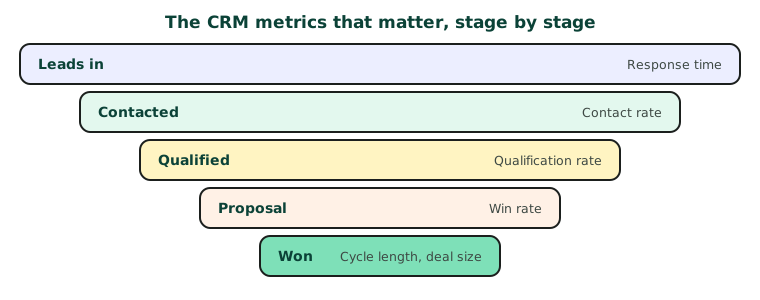
The six metrics
| Metric | How to calculate it | What it tells you |
|---|---|---|
| Response time | Time from a lead arriving to the first real reply, as a median | Whether leads go cold before you speak to them |
| Contact rate | Leads you reached ÷ leads you tried to reach | Phone and email quality, and calling times |
| Qualification rate | Qualified leads ÷ leads contacted | Whether marketing brings the right people |
| Win rate | Deals won ÷ deals that reached proposal | How well you sell once someone is serious |
| Sales cycle length | Median days from lead to won | Cash flow, and where deals stall |
| Average deal size | Total won value ÷ number of deals won | Pricing and which services to push |
Use the median rather than the average for times. One deal that took a year should not hide the fact that most close in three weeks.
Two more for the CRM itself
- Stale deals: open deals with no activity in 30 days. A rising number means the pipeline is less real than it looks.
- Data completeness: the share of new leads with a source, an owner and a phone or email. Below 90%, every other metric is shaky.
Setting up your CRM so the numbers are right
- A lead source on every record, set automatically by the form, ad or integration that created it.
- Stages with dates. Most CRMs record when a deal entered each stage; make sure reps move deals, rather than editing a status field.
- Calls and emails logged automatically, from your phone system and email, so response time and contact rate are measured, not guessed.
- One definition of “qualified”, written down and agreed by sales and marketing.
Where to find these reports
| CRM | Where to start |
|---|---|
| HubSpot | Reports: deal funnel and sales velocity reports (fuller reporting on paid tiers) |
| Pipedrive | Insights: deal conversion, deal duration and activity reports |
| Zoho CRM | Analytics: conversion and pipeline reports; Ultimate adds advanced analytics |
| Salesforce | Reports and dashboards, with opportunity history for stage timing |
| GoHighLevel | Opportunities and reporting dashboards, per sub-account |
Review them in 15 minutes a week
Look at the six numbers every Monday, compared with the last four weeks. Pick the one that moved most in the wrong direction and ask why. That habit does more for sales than any new feature.